Introduction: Thermomechanical Testing and Simulation
How do welded steels behave under extreme conditions, and what happens to their properties when exposed to intense heat and mechanical loads? This section of the MOWSES Insight Hub clarifies key questions related to thermomechanical testing and simulation methods used in MOWSES to investigate how welding affects the behaviour and performance of steels, particularly within the Heat Affected Zone (HAZ).
The topics covered here form the experimental and analytical foundation for understanding material behaviour under welding conditions. These methods allow researchers to reproduce welding conditions in a controlled way, isolate critical microstructural regions, and systematically evaluate how materials respond to combined thermal and mechanical influences.
This knowledge is essential for MOWSES as it provides the high-quality data needed to understand material behaviour at a fundamental level. The insights gained support modelling, material optimisation, and structural assessment across the project. Ultimately, this contributes to the overarching goal of MOWSES: improving the safety, reliability, and performance of welded steel structures in demanding environments.
1. What is a Gleeble test?
A Gleeble test is a thermomechanical experiment performed using the Gleeble 3800 system, a physical simulation device developed by Dynamic Systems Inc. The equipment enables precise control of temperature, heating rate, cooling rate, and mechanical loading on a small material sample. This controlled environment allows us to replicate the thermal and mechanical conditions experienced during welding and to reproduce specific microstructural regions, such as those found within the Heat-Affected Zone (HAZ). By isolating these zones individually - something that is extremely difficult to achieve using real welds - we can systematically investigate their behaviour, characterise property changes, and assess material performance under welding related conditions.
2. What are thermomechanical simulations?
Thermomechanical simulations are computational analyses, typically based on Finite Element Analysis (FEA), that model the coupled interaction between thermal and mechanical fields within a material or structure. These simulations predict how temperature variations influence deformation, stress development, and overall structural response.
They are widely used to evaluate structural integrity, assess thermal stress evolution, and optimize manufacturing and joining processes, including welding, by providing insight into material behaviour under combined thermal and mechanical loading conditions.
3. What is a Charpy impact test?
The Charpy impact test is a standardised method used to measure how much energy a material absorbs when it fractures under a sudden impact. Developed in the early 1900s, it remains widely used because it is simple, quick, and cost effective, yet provides valuable insight into a material’s toughness. In the test, a heavy pendulum is released from a known height and strikes a notched specimen. By comparing the pendulum’s height before and after the impact, the machine determines how much energy the sample absorbed during fracture. A higher absorbed energy indicates a tougher, more ductile material; a lower value suggests more brittle behaviour.
In addition to the numerical energy measurement, the fracture surface itself provides qualitative information. A flat, shiny surface typically indicates a brittle fracture. A rough or fibrous surface with shear lips suggests ductile failure.
Together, these observations make the Charpy test a practical tool for evaluating how materials respond to sudden loading.
4. At which temperatures is the steel tested and why?
The steel specimens are tested across a temperature range from approximately −100 °C to 0 °C. This range is selected for two key reasons.
First, many steels are used in offshore or cold climate environments, where low ambient temperatures can significantly influence material performance. Testing at sub zero temperatures ensures that the selected material remains safe and reliable under realistic service conditions.
Second, steels change their fracture behaviour with temperature. At higher temperatures, steels are typically ductile, meaning they can absorb more energy and deform plastically before breaking. At lower temperatures, they become more brittle, leading to sudden, rapid failure with minimal deformation. Identifying the temperature at which this change in behaviour occurs, known as the ductile to brittle transition temperature, is essential for safe structural design. Testing the material at multiple temperatures allows us to accurately determine this transition point.
5. What is a fracture toughness test?
A fracture toughness test measures a material’s ability to resist the growth of a crack. Materials with high fracture toughness can withstand significant stress before a crack propagates, whereas materials with low toughness may fail suddenly even under relatively small loads.
To evaluate fracture toughness, the test specimen is intentionally given a controlled defect, typically a sharp notch or a pre crack, to simulate a realistic flaw. The specimen is then loaded in a defined manner until the crack begins to grow. The resulting measurement provides a quantitative value that reflects the material’s resistance to crack initiation and propagation.
Fracture toughness is a critical parameter in assessing the safety and reliability of structures, especially those subjected to high stresses, dynamic loads, or harsh environments.
6. What is a tensile test?
A tensile test is one of the most fundamental tests in materials science and engineering. During a tensile test, a specimen of specific geometry is subjected to a controlled tension loading until the point of failure. Specimens for tensile tests can be made having either round or square sections.
A series of properties can be directly measured from a tensile test. These include the ultimate tensile strength of the material, the strength at fracture, the maximum elongation of the sample up to the point of failure, as well as the reduction in the cross-sectional area of the specimen.
In addition to these, there is a series of material properties which can be derived from the measurements obtained during a tensile test. Such properties include the Elastic Modulus of the material (also known as Young’s Modulus), the Poisson’s ratio (which denotes the deformation of the material in the directions perpendicular to the direction of loading), the yield strength (the limit of the purely elastic or fully recoverable behaviour of the material), and also the specific characteristics of the strain-hardening behaviour of the material. This last property concerns the tendency of metals to increase their strength when they are being permanently deformed.
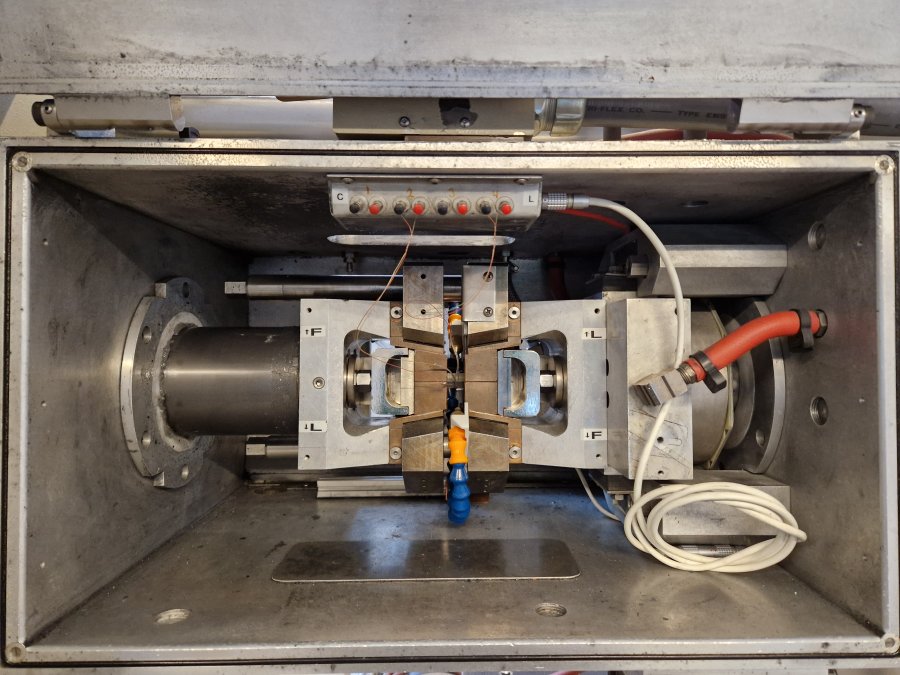 The set-up used for the simulation of the GMAW process for obtaining the Coarse-Grained Heat-Affect Zone using the Gleeble thermomechanical simulator.
  Close-up of the set-up used for the simulation of the GMAW process for obtaining the Coarse-Grained Heat-Affect Zone using the Gleeble thermomechanical simulator.
 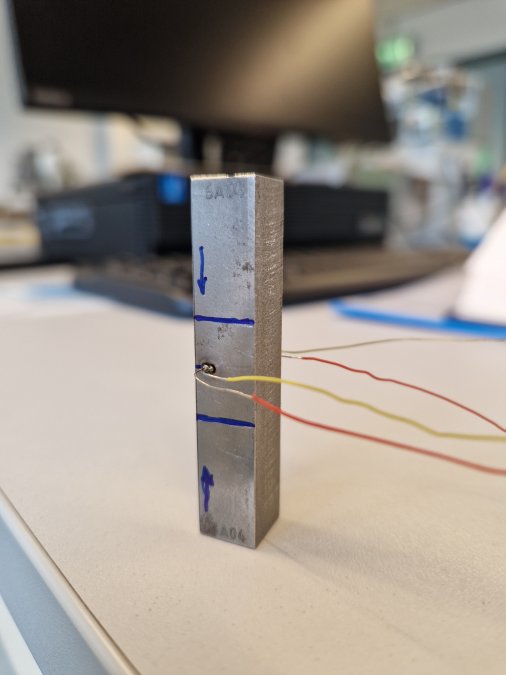 A standard-sized Charpy impact test sample prepared for the simulation of the Coarse-Grained Heat-Affect Zone using the Gleeble thermomechanical simulator.