Introduction: Welding effects on steel
The MOWSES project focuses on enabling the use of steel with higher levels of residual elements, while ensuring that the final steel components remain safe, reliable, and suitable for critical infrastructure applications. In those applications, steels are almost always welded. Since the heat of the welding process can change the microstructure and properties such as strength, hardness and toughness of the steel, in MOWSES we particularly focus on the heat-affected-zone of the weld. But what exactly happens when steel is welded? How do we measure the thermal stress on the material? And how can we ensure that the welded steel components are safe?
1. What is a welding thermal cycle?
In fusion welding of metallic materials, a connection is formed by locally melting and mixing the materials to be joined, often with addition of extra (filler) material. Fusion welding therefore requires heating of the materials to above their melting point, of the order of around 1500 oC for most steels. Upon subsequent cooling and re-solidification of the molten material mix, a solid joint is then created.
As the heating and melting is generally to be limited to a relatively small area (typically of the order of square millimetres to centimetres), very fast heating is required, while the rest of the component remains at much lower temperature. This can be realized for example by a welding arc. The heat source is then traversed along the prospective weld line, to make a weld over a longer area. As a consequence, any point along the weld line will see a very rapid temperature rise as the heat source approaches, followed by cooling, when it has passed and the heat is drawn out by the surrounding cooler material. This heating and subsequent cooling at a certain point along the weld is referred to as the welding thermal cycle for that point. It is mainly characterised by the peak temperature reached and the speed with which cooling takes place. In addition, a point may see multiple – and non-identical – welding cycles in the case of multi-pass welding, where the heat source passes over the same location multiple times.
The welding thermal cycle is one of the prime parameters determining the final weld zone properties (together with the chemical composition of the weld metal and the starting micro-structure in the heat-affected zone just next to that). From the welding thermal cycle, particularly the cooling time from 800 to 500 oC – the so-called t8/5 – is known to be most influential for the final mechanical properties of the weld zone in steels. For many steels, therefore, the steel manufacturer specifies a range of t8/5 cooling times for which the resulting weld zone properties are known to be acceptable.
To make the translation from t8/5 to actual welding parameters, calculation tools exist that allow prediction of the expected t8/5 as a function of mainly welding heat input, joint geometry and sample thickness. Using such tools, the t8/5 range specified by the steel manufacturer can thus be translated to actual welding parameters to be used for a specific combination of steel grade(s), part thicknesses and welding parameters, making sure the welding thermal cycle will yield acceptable weld properties.
2. How do we test the effects of welding on the steel?
Fusion welding generates a mixed zone, consisting of the weld metal and the heat-affected zone, with ‘weld metal’ referring to the material that was actually molten by the welding process and where filler metal may have been added, giving a different chemical composition from that of the base material. The weld metal is surrounded by the heat-affected zone (commonly referred to as HAZ), where elevated temperatures up to about the melting temperature have caused metallurgical modifications to take place, such as grain growth, phase changes and modification of precipitates. The HAZ is a mixed material zone itself, with layers with different microstructure and properties, following from the peak temperature locally reached. Generally, four layers are recognised in the HAZ of a simple weld in steel.
For a certain material (for example a certain steel grade), many parameters determine the final mechanical properties of a welded joint. The most important for a certain steel in this respect are the 800 to 500 oC cooling time (t8/5) and the filler metal (strength class), if filler is used. Both of these affect the weld metal; only the first one really affects the structure of the heat-affected zone. When testing a steel for the effects of welding, both of these aspects are covered.
Firstly, for welds using filler metal addition, a suitable filler wire composition needs to be selected. For many steel grades, suitable filler metals have been developed, but if the steel base material composition is very different from existing ones, filler metal of a new composition may also need to be developed. This is generally done by filler metal manufacturers, in cooperation with steelmakers. Experimental (welding) trials are then conducted using different filler compositions and the performance of these is then tested.
For the HAZ, the response of the steel base material (of a certain composition and microstructure) to typical welding thermal cycles is tested. This can be done with actual welding experiments, but also experimental simulation methods exist, such as dilatometer experiments, Gleeble thermo-mechanical simulations and even numerical simulation. The simulation methods are mostly used early in a steel’s development, when only small experimental batches of material may be available, insufficient for actual welding experiments.
With these simulation methods, the effects of different welding thermal cycles (i.e. representing different t8/5 cooling times) are investigated and these results can be used to improve further the steel grades weldability (for example by modifying the alloying additions or base material microstructure). Typical mechanical properties that are considered are the material’s hardness and strength (which are linked), but depending on the foreseen application for example also toughness or corrosion resistance, for example.
Generally, the final step to test the effects of welding on the steels is performing actual weldability investigations, which mainly serve two purposes. Firstly, to establish the so-called operational weldability, meaning the possibility to make good quality welds, without defects such as cracks. Secondly, to establish the metallurgical weldability, meaning the ability of the material to go through a welding cycle (or multiple, in the case of multi-pass weldss) without losing the specified minimum level of strength and toughness, for example. These welding tests therefore typically focus on the selection of filler metal and the allowable range of the t8/5 cooling time. The latter can then be translated to actual welding parameters tailored to the application and welding practice of customers.
 Macrograph of a cross-section of a bead-on-plate weld showing the weld metal and heat-affected-zones (HAZ), illustrating how the welding thermal cycle influences the steel microstructure. © OCAS NV
 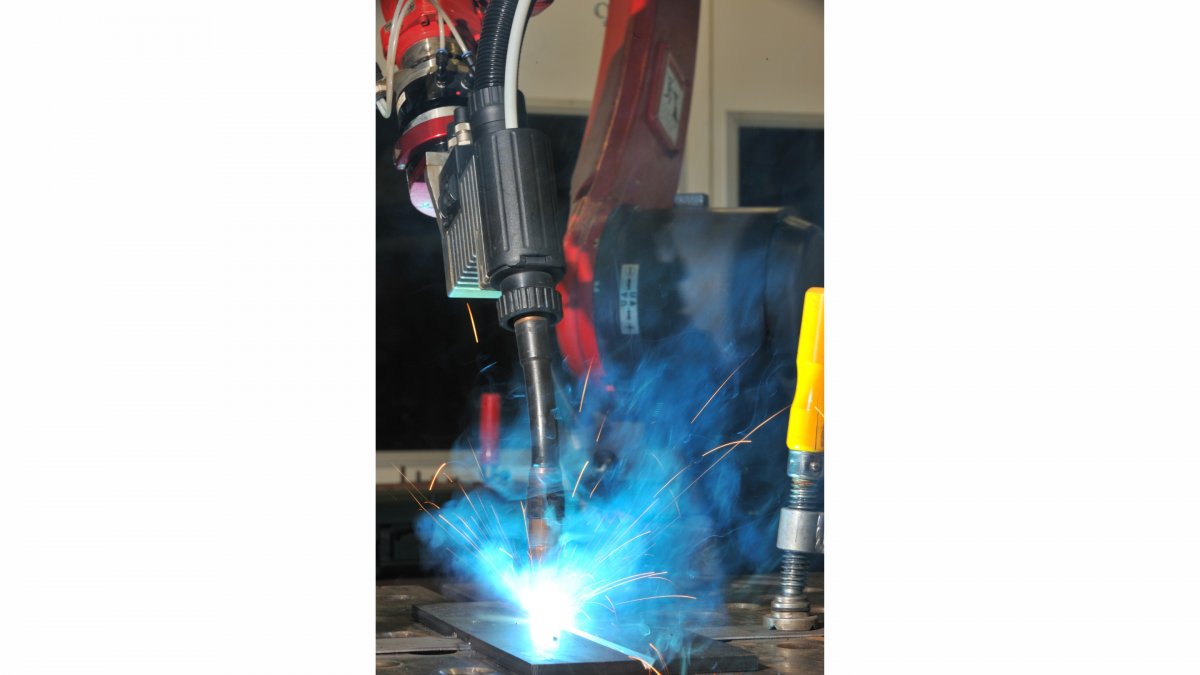 Welding experiment performed on a small-scale test sample to investigate how welding affects the properties and performance of steel. © OCAS NV