Investigating Weldability for the Next Generation of Green Structural Steels
As MOWSES develops green structural steels, ensuring these materials can be welded safely and reliably is an essential step towards their future industrial application. The project's research on weldability aims to understand how recycled steel behaves during welding and whether residual elements introduced through steel scrap influence the performance of welded components.
First Welding Trials Underway
The current investigations focus on experimental batches of S355 structural steel – popular European standard non-alloy structural steel characterised by a minimum yield strength of 355 MPa, good weldability, and high load-bearing capacity. So far, the research team has completed the first welds on the project's reference material, following initial trials on commercially available S355 steel. These reference experiments provide the basis for evaluating future MOWSES steel batches.
The welds are produced using the Gas Metal Arc welding process (GMAW), a standard method in structural steel fabrication, using a 1.0 mm welding wire and a shielding gas containing 18% CO₂ and remainder argon. Multi-pass butt welds are manufactured while monitoring key parameters such ast8/5 cooling times, which strongly influence the microstructure and properties of the heat-affected zone.
Assessing Crack Susceptibility
To evaluate weldability in more detail, researchers are preparing specialised test specimens for two established methods:
- The Implant Test investigates the material's susceptibility to cold cracking by applying increasing static loads to welded specimens.
- The Circular Patch Test evaluates the hot cracking susceptibility of the steel by generating thermal stresses during controlled melting.
These tests will help determine how the experimental steels respond to the demanding conditions experienced during welding.
Understanding the Impact of Recycled Steel
A key objective of the research is to assess how residual elements introduced through recycled steel scrap affect weld performance. These elements may promote hardening or crack formation in the heat-affected zone, potentially influencing the reliability of welded structures – a welded component made from recycled steel may fail, whereas the same component made from pig iron would not fail.
This is why, the welded samples will undergo tensile testing in accordance with DIN EN ISO 4136, Charpy impact testing in accordance with DIN EN ISO 9016, and metallographic examinations using micrographs, complemented by crack susceptibility tests as the project progresses.
As only the reference material has been welded so far, it is still too early to identify trends. Nevertheless, these first investigations mark an important step towards ensuring that future low-carbon structural steels can meet the same high welding and performance standards as conventional materials.
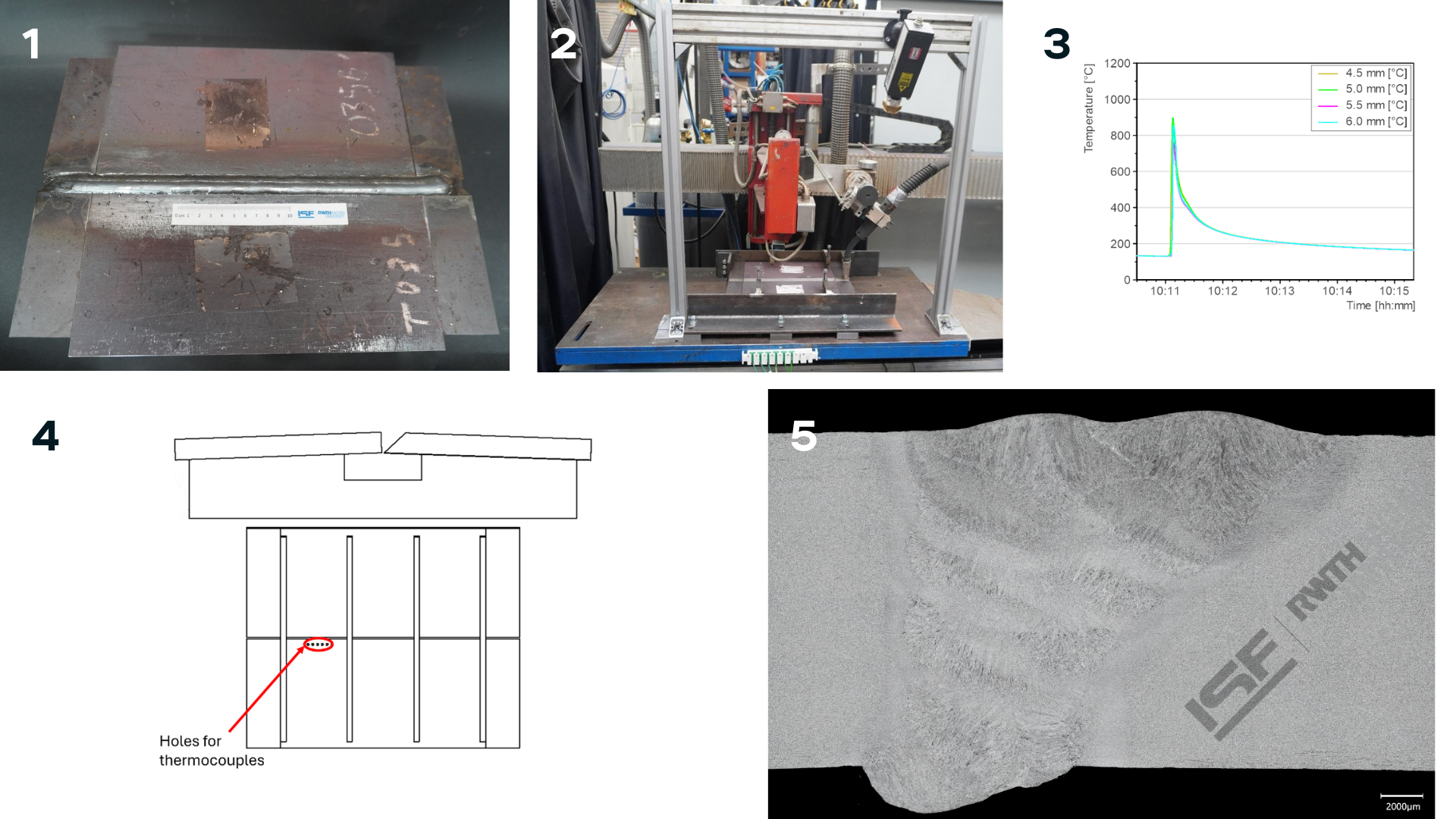
1 Multipass-joint weld on the S355 reference scrap batch material. 2 Setup: Stationary welding torch and movable table; Pyrometer for measuring the temperature at the weld seam surface. 3 The given figure shows an exemplary temperature measurement of one weld pass. 4 A HV-Seam preparation with a gap of 2 mm and an angle of 45° is used for the joint welds. In order to compensate distortion, the plates are stiffened. On the angled flank side multiple holes of increasing depth are prepared for thermocouple measurement within the heat affected zone. 5 Crosssection of a multipass-weld.