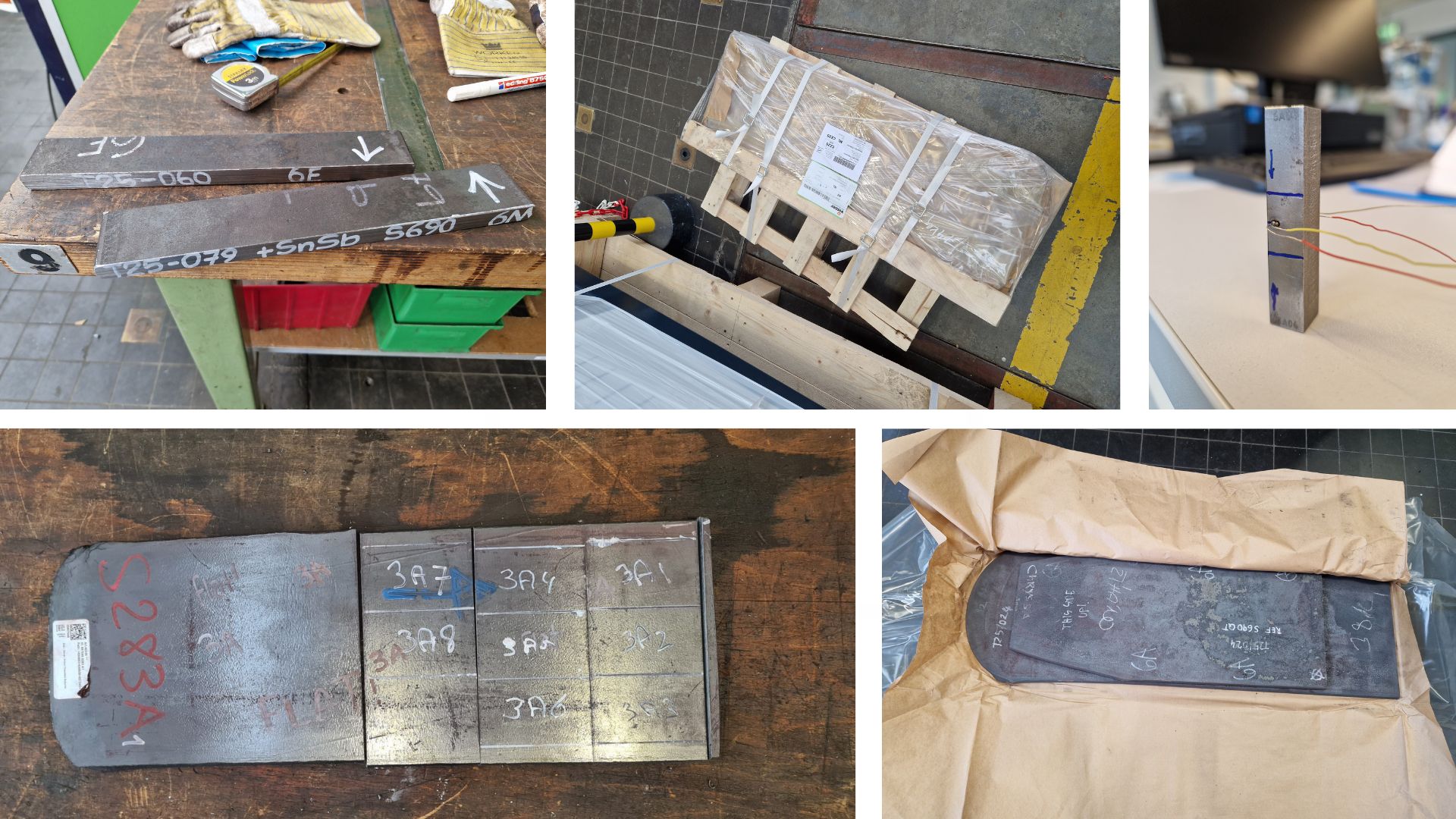
Milestone in MOWSES: Steel Plates Arrive at TU Delft
The MOWSES project has reached an important milestone as testing samples from Comtes FHT have arrived at TU Delft, enabling the start of work within Work Package 3 (WP3), which focuses on thermomechanical welding simulations. WP3 is dedicated to investigating the thermomechanical behaviour of welded materials, with a particular focus on the Heat Affected Zone (HAZ), a critical region within the welded steel. This work significantly contributes to understanding how welding processes affect the structural performance of advanced steels, answering key questions in the MOWSES project.
Upon receipt of the steel plates at the TU Delft laboratories, material preparation begins with the extraction of standardised test specimens. In the initial phase of the MOWSES project, Charpy impact specimens are machined from hot rolled steel plates using controlled cutting and milling procedures to ensure dimensional accuracy and reproducibility.
To replicate the thermal cycle experienced during welding, these specimens are subsequently subjected to thermomechanical simulation using the Gleeble 3800 physical simulation system. This process is configured to reproduce the conditions associated with the formation of the Coarse Grained Heat-Affected Zone (CGHAZ) characteristic of Gas Metal Arc Welding (GMAW). The CGHAZ is one of several metallurgical sub regions within the Heat Affected Zone (HAZ), distinguished by significant austenite grain coarsening due to peak temperatures approaching or exceeding the upper austenite transformation range.
Although the chemical composition of the HAZ remains identical to that of the parent steel, the welding thermal cycle induces substantial microstructural transformations, including grain coarsening, phase redistribution, and potential precipitation or dissolution phenomena. These microstructural alterations can critically influence local mechanical properties, particularly toughness, and therefore have significant implications for the structural integrity and reliability of welded steel components.
Following Gleeble simulation, the specimens are fractured using Charpy impact testing to quantify the low temperature toughness associated with the CGHAZ microstructure. Complementary characterization methods are employed to provide a comprehensive assessment of the simulated HAZ, including Vickers hardness measurements to map local mechanical property variations; optical microscopy to examine grain structure, phase morphology, and the extent of microstructural transformation resulting from the thermal cycle.
This methodology enables a controlled, reproducible investigation of the CGHAZ in isolation, something that is difficult to achieve using full scale welded joints. The objective is to evaluate how variations in steel composition, particularly the presence of residual or trace alloying elements, influence the toughness and overall performance of the HAZ. The findings will contribute to improved material design strategies and support the development of safer, more reliable welded steel structures.
For readers interested in learning more about specific methods such as Gleeble testing and other experimental techniques, further explanations are available in detail on the MOWSES Insight Hub.